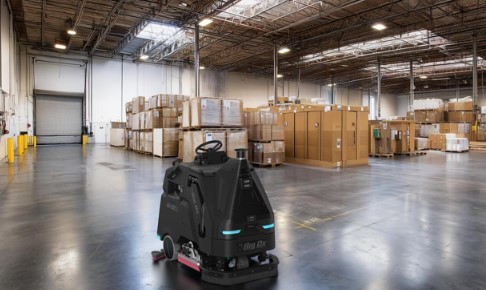
Maintaining clean floors in a large facility has never been simple, and it’s only getting harder. Rising labor costs, persistent staffing shortages, and growing operational demands are pushing more companies toward the autonomous floor scrubber as a way to clean smarter—not just harder.
Instead of pulling employees off their primary jobs to push a scrubber around, automation lets facilities keep floors clean while actually improving overall productivity. Here’s how.
The Link Between Cleaning and Productivity
In most facilities, floor cleaning is treated as a secondary task—something that gets done when there’s time, or that gets handed to employees who already have a full workload. That approach creates a chain of problems:
- Cleaning competes directly with core operations for time and labor
- Pulling workers off production, logistics, or maintenance to run a scrubber reduces their output
- Cleaning gets delayed or rushed, leading to inconsistent results and safety issues
Automation breaks this cycle by making cleaning a predictable, non-disruptive background process—one that runs on schedule without pulling a single person off their actual job.
Reducing Dependence on Cleaning Labor
Labor shortages and rising wages have made it increasingly difficult—and expensive—to maintain dedicated cleaning staff. With traditional methods, workers spend hours operating machines, new hires need training to use equipment properly, and cleaning quality depends entirely on individual effort and consistency.
A robotic floor scrubber changes that equation fundamentally. Program it once, and it handles the job on its own—no supervision required.
This allows facilities to:
- Reassign workers to higher-value tasks like production, shipping, or quality control
- Reduce or eliminate the need to hire dedicated cleaning staff
- Maintain consistently clean floors without tying up labor hours
Continuous Operation Without Interruptions
One of the most impactful productivity gains from automation is continuous operation. Manual cleaning is constrained by shift schedules, operator availability, and fatigue—all of which limit when and how long cleaning can happen.
An autonomous floor scrubber doesn’t have those constraints. Advanced units can run 13+ hours per cycle and return to a docking station on their own for water refills, tank dumps, and battery charging. Once serviced, they resume cleaning automatically—no human intervention needed at any point.
The result: floors stay clean around the clock without disrupting operations or requiring anyone to babysit the process.
Consistency That Drives Efficiency
Consistency is a productivity multiplier that’s easy to overlook. When cleaning is irregular, the consequences ripple through your operation:
- Dust and debris accumulate, creating drag on equipment and slowing material handling
- Dirty aisles make it harder for forklifts and workers to move efficiently
- Safety hazards increase, leading to incidents that cause real downtime
An automatic floor scrubber machine follows the same optimized route every cycle, covering the entire facility uniformly. No corners cut, no areas skipped. More advanced systems even refine their cleaning patterns over time, reducing wasted movement and maximizing coverage per session.
Smart Navigation in Dynamic Environments
Facilities like warehouses and manufacturing plants are constantly changing. Pallets get moved, equipment shifts, workers are everywhere. Navigating that environment manually requires constant attention from an operator.
Modern industrial floor cleaning robots handle this with advanced navigation systems that:
- Detect obstacles in real time using LiDAR and camera systems
- Automatically reroute around blocked paths without stopping
- Continue cleaning through shifting layouts without human intervention
The machine adapts to what’s in front of it and keeps working. No downtime, no babysitting, no wasted cycles waiting for someone to come move a pallet.
Freeing Up Time Across Daily Operations
The productivity impact of autonomous cleaning goes beyond just the cleaning itself. By eliminating manual operation, the ripple effects touch every part of your daily workflow:
- Employees stay focused on their primary responsibilities instead of getting pulled for cleaning duty
- Cleaning schedules become predictable and reliable—no more “we’ll get to it when we can”
- Large floor areas get covered more efficiently, with less total time spent on the task
Over weeks and months, these incremental time savings compound into meaningful productivity gains and better resource utilization across your entire operation.
Lowering Long-Term Costs
Autonomous cleaning requires a real upfront investment, but the long-term financial picture is where it pays off.
Facilities save through:
- Significantly reduced labor expenses—often the single biggest cost in facility maintenance
- Lower training costs since the machine performs consistently regardless of staffing changes
- Fewer cleaning inconsistencies that lead to rework, floor damage, or safety incidents
Some systems also eliminate recurring software or subscription fees, giving you full ownership of the machine’s capabilities with no ongoing licensing costs eating into your savings.
Supporting Growth and Scalability
As facilities expand, cleaning demands scale with them. Manual methods that worked at 50,000 square feet start breaking down at 150,000. You need more staff, more shifts, more supervision—and the costs multiply.
Autonomous floor scrubbers for warehouses offer a scalable solution that:
- Covers more space without proportionally increasing headcount
- Delivers consistent results regardless of how much floor area you’re managing
- Supports high-demand, multi-shift operations without adding complexity
For businesses planning for long-term growth, autonomous cleaning is an investment that scales with you instead of against you.
The Bottom Line
Improving productivity isn’t just about increasing output—it’s about eliminating inefficiency and making better use of the resources you already have. The right autonomous floor scrubber reduces labor pressure, delivers consistent cleaning results, and frees your workforce to focus on what actually drives your business forward.
If floor cleaning is currently competing with your core operations for time, labor, and attention, that’s a problem worth solving—and automation is the most practical way to solve it.